Vice-President Election

Vice-President election
The office of the vice president in India is modeled after that in the United States.

India’s vice-president is the second-highest position in the nation.

Additionally, Article 63 of the Indian Constitution refers to the Vice President’s position.

The current vice president of India and ex-officio chairman of the Rajya Sabha is Muppavarapu Venkaiah Naidu.

The Bhartiya Janata Party (BJP) named West Bengal Governor Jagdeep Dhankhar as the National Democratic Alliance (NDA) nominee for the Vice Presidential elections.

While Margaret Alva, the opposition’s candidate for vice-presidential election, filed her candidacy, she stated that winning and losing is part of life and that the opponent struggles to uphold the pillars of democracy, strengthen institutions, and for an India that belongs to “every one of us”.

Some information on the two nominees:

Jagdeep Dhankar

He is a politician from India who served as the governor of West Bengal.
Before becoming the governor of West Bengal, he belonged to the Bharatiya Janata Party.
Dhankhar initially concentrated on the Supreme Court of India starting in 1990. He also presented his case in numerous Indian High Courts.
In addition, he held the position of President of the Jaipur-based Rajasthan High Court Bar Association.
Dhankhar represented the state of Haryana in an appearance in the Sutlej River water dispute in 2016 and made an argument before the Indian Supreme Court.

Margaret Alva

She is an Indian politician. Alva held the offices of the 23rd Governor of Gujarat, the 20th Governor of Rajasthan, the 17th Governor of Goa, and the 4th Governor of Uttarakhand from August 2013 till the conclusion of her term.

She formerly held the position of Cabinet Minister.

She held a prominent position in the Indian National Congress and represented as Joint Secretary of the All India Congress Committee before being named governor.
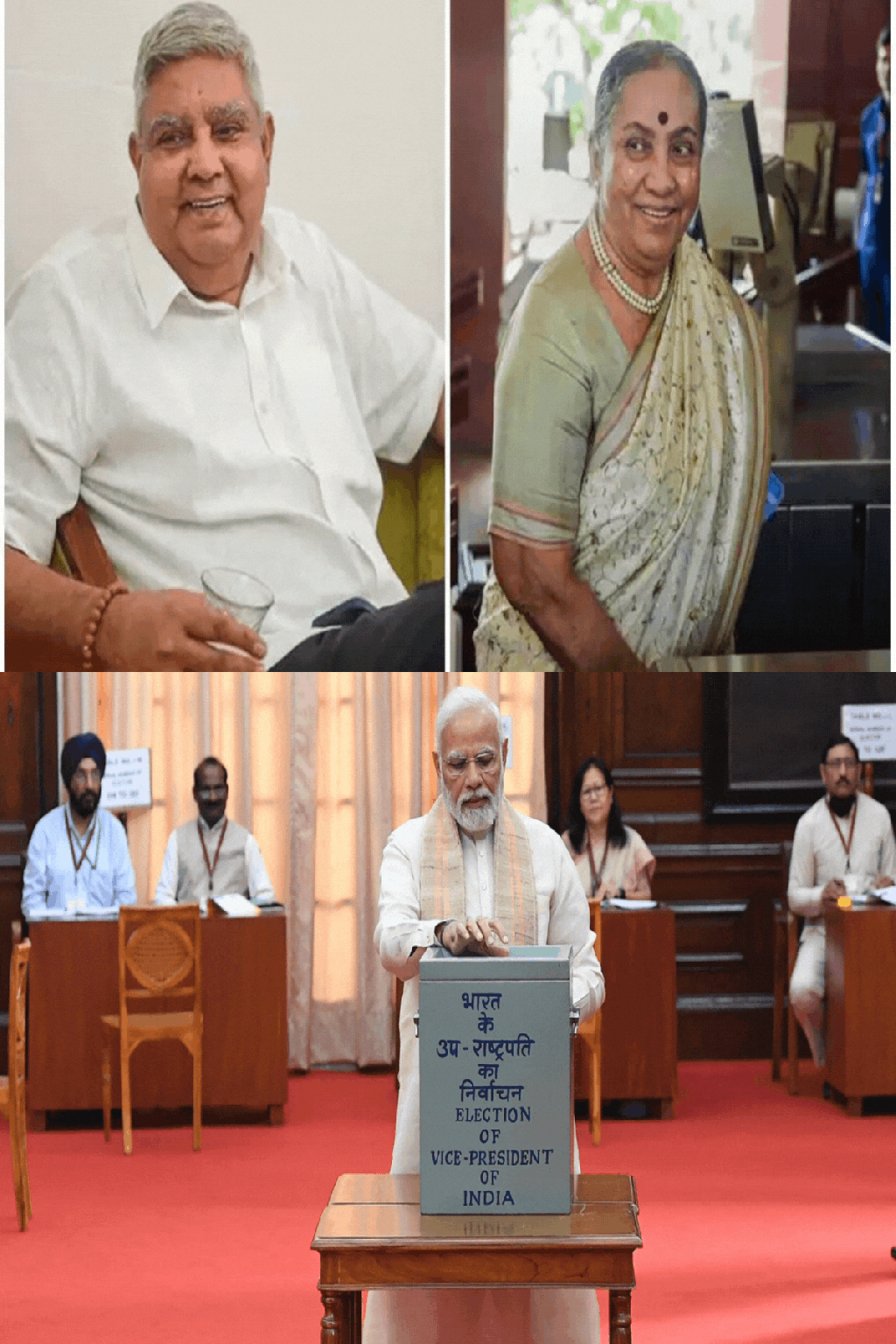
Constitutional Provision of Election of Vice-President of India

On 6th August Parliament will vote for the 16th Vice-President

Part V The Union Article 63 to 71 of the Constitution of India deals with the Vice-President

Article 63- There shall be a Vice President of India.

The Vice-President is the 2nd highest dignitary of India. His office was created to maintain the political continuity in India. He serves as an acting President when the office of the President falls vacant due to resignation, death, or otherwise (Article-65)

He is elected by an electoral college consisting of all members (both elected and nominated) of Parliament(of Lok Sabha and Rajya Sabha) (Article-66).

The tenure of the Vice-President is Five years from the date upon which he enters his office and he can only be removed by resolution of Rajya Sabha and agreed by Lok Sabha. To move a such resolution, a 14 days notice to be given. (Article-67)

He is the Ex-officio Chairman of Rajya Sabha. He has similar power as the Speaker or Lok Sabha.

Eligibility to be appointed as the Vice- President (Article-66)
Should be a citizen of India.
Should have completed 35 years of age.
Should be qualified for election as a member of the Rajya Sabha.
Should not hold any office of profit under the Union government or any state government or any local authority or any other public authority.

What is the Election Procedure?

As per Article 68 of the Constitution, the election to fill the vacancy caused by the expiration of the term of office of the outgoing vice-president is required to be completed before the expiration of the term.

Article 324 of the Constitution read with the Presidential and Vice-Presidential Elections Act, 1952 and the Presidential and Vice-Presidential Elections Rules, 1974, vests the superintendence, direction and control of the conduct of election to the office of the Vice-President of India in the Election Commission of India.

The notification for election shall be issued on or after the sixtieth day before the expiration of the term of office of the outgoing Vice-President.
Since all the electors are members of both Houses of Parliament, the value of the vote of each Member of Parliament would be the same i.e.1 (one).

The Election Commission, in consultation with the Central Government, appoints the Secretary-General of Lok Sabha and Rajya Sabha, by rotation, as the Returning Officer.


Accordingly, the Secretary-General, Lok Sabha will be appointed as the Returning Officer for the present election to the Office of the Vice-President of India.
The Commission also decides to appoint Assistant Returning Officers in Parliament House (Lok Sabha) to assist Returning Officers.


As per Rule 8 of the Presidential and Vice-Presidential Elections Rules, 1974, polls for the election are taken in the Parliament House.